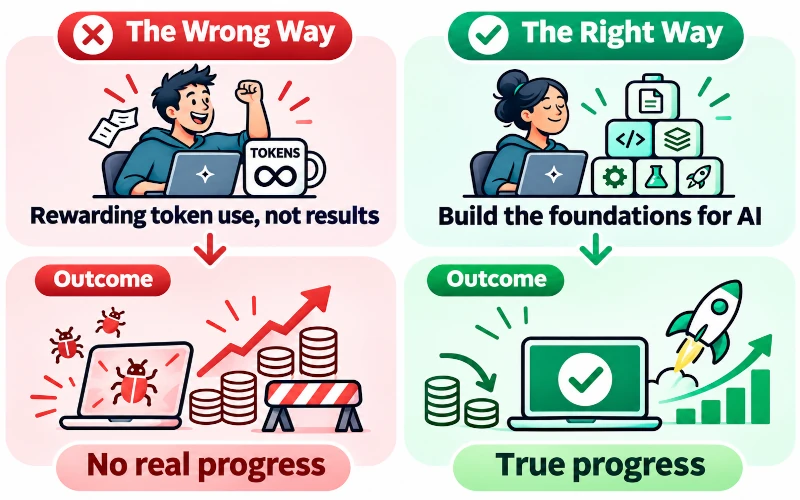
There is a wrong way and a right way to approach AI transformation in software engineering.
Unfortunately, a lot of companies seem to be choosing the wrong one.
Let's start with what not to do.
The wrong way: adoption for the sake of adoption
The recipe is simple:
- Give everyone an AI coding assistant licence.
- Let everyone spend as many tokens as they want.
- Encourage adoption.
- Reward the people who consume the most tokens.
Congratulations! You now have an AI transformation programme.
Except you don't.
You have a token consumption programme.
What happens next?
At first, everything looks great. Everyone is experimenting, generating code, building prototypes and showing impressive demos.
There is a lot of motion.
But look a little closer.
Actual progress is nowhere to be seen.
Meanwhile:
- Code quality deteriorates. More bugs are introduced, and the codebase becomes increasingly brittle.
- Token consumption goes through the roof.
- Testing and verification become the new bottlenecks. AI can generate code much faster than the organisation can establish whether that code is actually correct.
- Delivery becomes increasingly unpredictable.
Eventually, someone notices the bill.
The organisation enters the inevitable cost-containment spiral:
- AI spending is too high.
- Management starts cutting costs.
- People are let go.
- There are fewer engineers available to review, test and maintain the generated code.
- Delivery slows down even further.
And so the organisation ends up spending more money, producing less reliable software and making less progress.
Lots of AI activity. Very little actual transformation.
The right way: fix the engineering workflow
AI doesn't magically remove the need for good engineering practices.
If anything, it makes them more important.
The real opportunity is to build an engineering organisation where AI can operate efficiently, safely and with confidence.
This means investing in the foundations.
Fully automate operations
Deployment, observability and alerting should be automated.
If releasing software still requires a sequence of manual operations, you're creating unnecessary friction.
AI can generate code at an incredible pace. Your operational infrastructure should not be the thing holding it back.
Build core services, libraries and design systems
Don't let every engineer or AI agent reinvent the same foundations.
Invest in reusable building blocks:
- Well-defined core services.
- Shared libraries.
- Consistent APIs.
- A common design system.
- Standardised architectural patterns.
The more predictable your environment is, the easier it becomes for AI to produce consistent results.
Invest in scaffolding and guardrails
This is probably the most important part.
Build the infrastructure that makes it easy to do the right thing and difficult to do the wrong thing.
In particular write documentation and executable specifications using TDD and BDD.
These are not overheads. They give AI a reliable environment in which to work.
Remove bottlenecks between development and release
If AI can generate a change in minutes but your release process takes days, you haven't solved the problem.
Reduce the friction between writing code and getting it into production.
Use feature flags and allow teh business to see the product while is being built.
Human in the loop is just another bottleneck
It goes without saying that an responsible human should be keeping an eye on the agent output. However, this should not become the new bottleneck.
If your question is "How can I be sure that the AI is creating what I meant to?"
My answer is: "have you read what I wrote about guardrails ?"
"Tests" are not just for testing, You should consider tham as the scaffold or better the mould of your code.
What happens when you get this right?
The results are very different:
- Fewer bugs and less rework.
- More consistent delivery.
- Token consumption stays under control because AI spends less time navigating ambiguity and fixing avoidable mistakes.
- Engineers naturally embrace AI because they trust the specifications, the tooling and the guardrails.
Notice something important here.
You don't need to force engineers to use AI.
When the engineering workflow is reliable, AI becomes an obvious productivity multiplier. Engineers will adopt it organically because they are confident in the system around it.
That's what real AI transformation looks like.
A practical workflow for building software with AI
I am sure you read impressive headlines about AI writing software in days, instead of months.
If you observe for a moment, you will notice that the starting point was either an already existing product or a fully tested specification.
Why?
Because AI shines when it is working with formally specified problems, with all corner cases documented and tested. You can't realistically expect the same performances if you give AI losely defined specifications written the day before.
I mean ... AI will try! It will make some assumption to make up for the lack of details. And you will never know which ones, until you find them out on a bug report! This makes autonomous coding perfectly viable for a prototype. But not always something you would like to put in front of your customers.
As Kent Beck says:
80% of a payroll system is the same as 0% of a payroll system.
Something mostly complete has no value until is completed.
To go all the way and create value you have to follow a reliable workflow:
Documentation first
Define what the software should do. Make requirements, interfaces and expected behaviour explicit.
Let AI build the scaffolding and guardrails
Ask AI to establish the project structure, generate tests and implement the infrastructure needed to validate future changes.
Manually verify the scaffolding and guardrails
This is the critical human intervention.
Don't blindly trust AI-generated tests. Make sure they actually verify the intended behaviour and catch meaningful regressions. Bad tests can also reveal issue in the documentation. Iterate and fix the documentation as well.
Let AI write the code with minimal supervision
Once the specifications, scaffolding and tests are trustworthy, AI can take over much of the implementation work.
You move from supervising every line of generated code to supervising the system that validates it.
That's a much better use of engineering time.
The bottom line
The right way to drive AI adoption is to create an environment where engineers have full confidence in the AI output.
Invest in automation, documentation, reusable foundations and tests.
Build the guardrails first. Then let AI accelerate development.
Here you go. I just saved you a few hundred grands in consultant invoices.
And if you're still wondering how to actually implement all this in your organisation, you can hire me.
I'm available!